A cheap ice fishing heater under $100, and what it gives up
One heater in our lineup sits in the under-$100 band, and it is a good one for a small shelter. This page shows what that lower price leaves out, which cheap shortcuts to avoid, and when the extra money for a bigger Buddy pays you back on the ice.
What “cheap” means for a shelter heater
We sort heaters by price band, never by price. Under $100 is the $ band and $100 to $180 is $$. Anything above $180 counts as $$$.
Of the five heaters in our ice fishing heater comparison, only one lands in the $ band on US retailer prices. That is the Mr. Heater Little Buddy MH4B, our budget pick, and most of this page is about what its lower price leaves out.
Bands are snapshots. The Portable Buddy sits right on the $100 line, so a sale can drop it under, while one seller lists the Little Buddy above it. Check the listing before you order.
The Little Buddy, our one heater under $100
The Mr. Heater Little Buddy MH4B is a compact radiant heater that sits on its own 1 lb propane cylinder. Mr. Heater rates it at 3,800 BTU on a single setting, for 95 sq ft in its spec field and up to 100 sq ft in its copy.
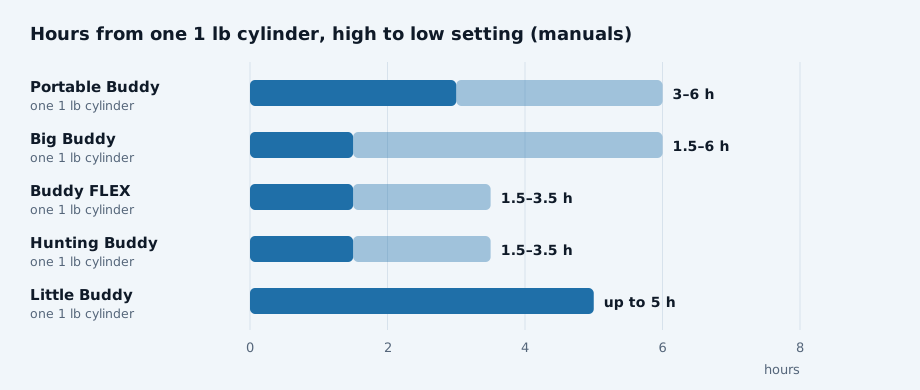
The manual gives about 5 hours from one cylinder, and the product page says 5.6. It lights with a piezo button you keep holding for 30 to 60 seconds once the pilot catches, and it needs no batteries.
Its safety kit matches the Portable Buddy’s: an ODS low-oxygen shut-off, tip-over protection and CSA 4.98 certification. The manual lists fishing huts among approved enclosures and asks for a fresh-air vent of at least 4 sq in, for example 2 × 2 in.
Retailers put it at about 5.9 lb without the cylinder, so it rides in a flip-over sled without a second thought. The full picture is in our Little Buddy review, and its card is pick 3 on the homepage.
What you give up under $100
A lower price buys a smaller heater, and the trade-offs are specific. None of them is a safety shortcut, but each one shows up on a cold, windy day.
- One heat setting, so you can’t turn it up when the wind shifts or down when the shelter gets stuffy
- About 95 to 100 sq ft of rated area, enough for a one- or two-person flip-over but not for a hub
- No remote-tank option, because the manual covers 1 lb cylinders only
- A slow igniter for some owners, who find the hold-down button fiddly with cold fingers
- Mixed durability reports, with some owners saying their unit lasted only a season or two
Many owners conclude that the Portable Buddy is the better long-term value. That view turns up often enough in owner feedback to weigh it before you pocket the difference.
Why cold hits a small heater hardest
Every Buddy manual warns of much shorter run times under continuous use below 20 °F. Propane only boils at around −44 °F, yet a small cylinder feeding a burner chills itself, loses pressure and frosts over.
Mr. Heater’s answer is a 20 lb tank on a hose, kept outside the shelter. The Little Buddy can’t take one, so on a subzero morning the cold cylinder sets the limit rather than the burner.
The physics, and what helps, are in our guide to cylinders that fade in deep cold. Keeping spare cylinders out of the wind, but never inside a closed shelter overnight, helps a little.
Is 3,800 BTU enough for your shelter?
For a one- or two-person flip-over on a mild day, owners say yes. In a hub much bigger than 100 sq ft, or on a windy subzero day, they report that it falls short.
Measure your floor before you buy. Our BTU guide for ice shelters works through floor area, wind and outside temperature, and shows where a 3,800 BTU heater stops keeping up.
The fuel arithmetic is reassuring. A 1 lb cylinder holds roughly 22,100 BTU, so a burner using 3,800 BTU an hour lands close to the 5 hours the manual gives, and a small heater is gentle on cylinders.
When to stretch to the Portable Buddy
The Mr. Heater Portable Buddy MH9BX is our top pick and sits in the $$ band, though some sellers list it under $100. It gives you 4,000 or 9,000 BTU and a rated 225 sq ft, more than twice the Little Buddy’s area.
It also connects by Buddy hose to a 20 lb tank that stays outdoors, which solves the cold-cylinder problem. The manual gives 3 to 6 hours per 1 lb cylinder and 48 to 110 hours on a 20 lb tank.
It needs a 9 sq in vent and weighs about 10.6 lb. Our Portable Buddy review covers it in full, and the Portable Buddy or Little Buddy page sets the two side by side.
The five heaters, band by band
The table lists each heater with its output, rated area and price band. Where sources disagree on area, you see the range.
| Heater | Heat output | Rated area | Price band |
|---|---|---|---|
| Little Buddy MH4B | 3,800 BTU/hr | 95–100 sq ft | $, the only one under $100 |
| Portable Buddy MH9BX | 4,000 or 9,000 BTU/hr | 225 sq ft | $$, sometimes under $100 on sale |
| Buddy FLEX MH11BFLEX | 8,000–11,000 BTU/hr | 275 sq ft | $$ |
| Hunting Buddy MH12HB | 6,000 or 12,000 BTU/hr | 300 sq ft | $$ (our estimate) |
| Big Buddy MH18B | 4,000, 9,000 or 18,000 BTU/hr | 450 sq ft | $$, some retailers higher |
The comparison table on the homepage adds run time, venting and weight for all five.
A Clam alternate in the same band
Clam’s CH-4200 is the other small shelter heater we found in the $ band. Clam rates it at 4,200 BTU for 105 sq ft, with up to 5 hours per 1 lb cylinder, an ODS and a tip-over switch.
It weighs about 4.75 lb. The Amazon listing we found showed it as unavailable, which is why it isn’t one of our five, but if you find it in stock it competes head-on with the Little Buddy.
Cheap traps to skip
Some Amazon bundles pair a Buddy heater with a 1 lb refill adapter. Skip that part, because PHMSA says DOT-39 cylinders of any size must never be refilled, and refilled cylinders have caused incidents, including a death.
A tank-top heater that screws straight onto a propane tank can look like a lot of heat for the money. Mr. Heater labels its MH15T “outdoor use only”, so a heater like that has no place in a closed shelter at any price.
Check the exact model too. Mr. Heater sells separate Massachusetts and Canada versions that are not rated for indoor use, so confirm the listing is the standard US heater.
A cheap heater burns oxygen like an expensive one. Open a roof vent and a floor-level vent, carry a battery CO alarm, and keep the heater well clear of fabric walls and gear.
The ODS shuts the heater off when oxygen runs low, but it does not sense carbon monoxide, and Minnesota DNR advises against relying on it. Store spare cylinders outside the shelter and never sleep with the heater running.
Our pick if you want to spend the least
For one or two anglers in a flip-over, the Little Buddy is the only heater of our five in the $ band, and it carries the same low-oxygen and tip-over protection as the larger Buddies. Buy it knowing it has one setting and no hose option.

