Frost and dripping walls from your heater, and how to stop it
Light a propane heater in a cold shelter and the roof soon grows frost, then drips on you once it warms. Most of that water comes from the heater itself, and you can’t stop it forming, only send it outside.
Where the water comes from
Burning propane makes two main products, carbon dioxide and water vapor. By the chemistry, each pound of propane burned gives off roughly 1.6 lb of water, about a pint and a half.
A Portable Buddy on high empties a 1 lb cylinder in a few hours, so a long day can add several pints of water to a small shelter. Every unvented propane heater does this, whether radiant or catalytic.
You add more of your own. Your breath, wet boots, snow on your jacket and the open fishing hole all put moisture in the air.
None of this is a fault in the heater. A shelter that frosts up is telling you that moist air has nowhere to go, and the same air carries the gases the vents are there to remove.
Why it frosts first and drips later
Warm, moist air rises to the roof and meets fabric that sits close to the outside temperature. The vapor turns to condensation there, and below freezing it builds up as frost.
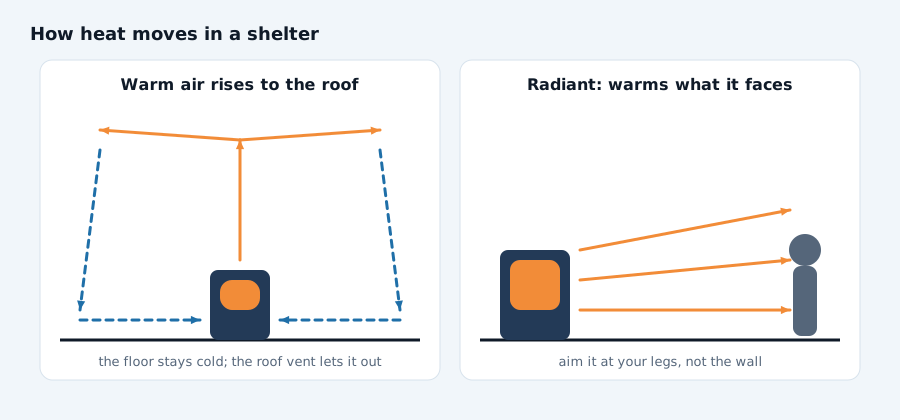
When the roof warms, or the sun hits it, the frost melts and drips onto you, your gear and the heater. Thin single-wall fabric frosts worst, while insulated hubs and hard-sided shacks keep their inner surface warmer.
Drips on the heater are more than a nuisance. Water landing on a hot burner face or around the controls is one more reason to keep the roof above it clear of frost.
Venting is the main fix
The vents that keep carbon monoxide down also carry moisture out. Minnesota DNR wants propane-heated shelters vented both high and low, so drier air enters near the floor and moist air leaves by the roof.
The manuals set the minimum per model, 4 sq in for the smallest Buddy and 18 for the largest. Treat those as floors, and the ventilation guide covers where to cut them.
Check the roof vent through the day. Fabric shelters turn nearly airtight when wet or covered in snow, which is one more reason to brush snow off the roof and the vents.
Never close the vents to keep heat in or to stop a drip. Moisture and carbon monoxide leave through the same openings, and a sealed shelter traps both of them with you.
Size the heater, then run it steadily
An oversized heater on high burns more fuel and makes more water than the space needs. An undersized one leaves the roof so cold that everything frosts, and it tempts you to shut the vents, which is worse.
Match rated heat to your floor area with the BTU guide, then pick a setting that keeps you comfortable without roaring. A variable heater such as the Buddy FLEX helps here, since it adjusts between 8,000 and 11,000 BTU.
Its manual calls for 11 sq in of opening near the ceiling and near the floor. That lines up with the top-and-bottom advice above, so one setup handles both air and moisture.
Shelter habits that cut the drips
Small habits add up over a long day in a hub. None of them replaces the vents, but together they keep a lot of water out of the air.
- Knock snow off boots and jackets outside before you zip the door
- Hang wet gloves well clear of the heater, never on it or over its face
- Brush frost off the roof before turning the heat up, so it falls as snow instead of water
- Keep a small towel for wiping drips off tackle and electronics
- Check that the roof vent is free of snow each time you step out
Don’t aim a radiant heater at a wall to dry it. The Portable Buddy manual asks for 30 in of clearance above the heater and 24 in in front, and fabric that close to the face can scorch or melt.
Radiant or catalytic, the water is the same
Some anglers expect a flameless catalytic heater to stay drier. It burns the same propane and makes the same water per pound, though a small catalytic model burns less fuel each hour and so adds less.
The radiant or catalytic guide weighs the rest of that choice. Shelter build matters as much, and sizing the heater to your shelter covers how flip-overs, hubs and shacks differ.
Drying out after the trip
Never pack a frosted shelter and leave it folded for days. Set it up or hang it loose at home until the fabric is dry, so mildew doesn’t start in the seams.
Shake out boots, gloves and bibs the same evening, and open the tackle trays so damp lures don’t rust. Gear left wet in the truck overnight often freezes into the shape you dropped it in.
Let the heater dry too, with the cylinder removed, before it goes back in its case. Store cylinders and tanks in a shaded spot away from living space.
For the heater itself, the best heater for an ice shack depends on shelter size and fuel, and the comparison table lines up all five. The before-you-buy tips add a few more habits worth building.
If you want steady, adjustable heat
The Buddy FLEX lets you set heat anywhere from 8,000 to 11,000 BTU, so you can run it at the level your shelter needs. It weighs more than the Portable Buddy, and one small cylinder runs it for only a few hours, so a 20 lb tank outside makes sense.