Venting an ice shelter with a heater, inch by inch
Every heater in a closed shelter burns your oxygen and gives back exhaust, so the vent is part of the heater, not an extra. The manuals put a number on it in square inches, and this guide turns that number into openings on a hub or flip-over.
Why a heated shelter needs two openings
A propane heater pulls oxygen out of the shelter air and puts back carbon dioxide and water vapor. When combustion goes wrong it adds carbon monoxide, so fresh air has to come in and stale air has to leave.
Warm air rises, which means one gap makes the exhaust and the fresh air fight over the same hole. Minnesota DNR wants every shelter heated with propane to have two openings, one up high and one down low.
The Big Buddy and Buddy FLEX manuals say the same in their own words, with openings at the ceiling and at floor level. The drawing below shows the idea on a hub.
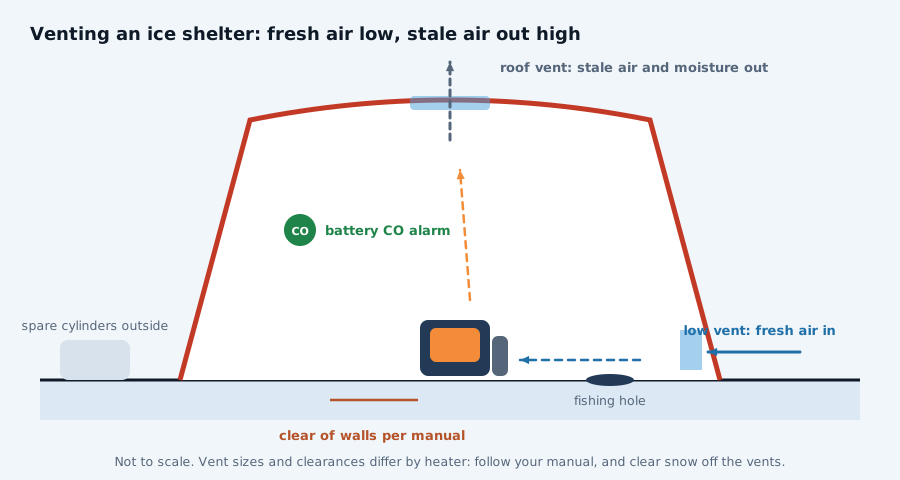
The low vent lets cold, fresh air in near the floor, and the roof vent lets warm, stale and damp air out. That damp air is what frosts your ceiling, the subject of our guide to frost and dripping walls.
How many square inches each heater needs
Each manual states a minimum fresh-air vent. Across the Buddy line it works out to about 1 square inch per 1,000 BTU of top output. A catalytic heater follows its own manual, so check its figure rather than this rule of thumb.
| Heater | Top output | Minimum vent | Manual’s example or note |
|---|---|---|---|
| Little Buddy | 3,800 BTU | 4 sq in | 2 × 2 in |
| Portable Buddy | 9,000 BTU | 9 sq in | 3 × 3 in |
| Buddy FLEX | 11,000 BTU | 11 sq in | 5.5 × 2 in, at the ceiling and at floor level |
| Hunting Buddy | 12,000 BTU | 12 sq in | The troubleshooting page says 9; go by 12 |
| Big Buddy | 18,000 BTU | 18 sq in | 4.25 × 4.25 in, at the ceiling and at floor level |
Where a manual gives one figure without saying where, we would give both the high and the low opening at least that much. Treat every figure in the table as a floor, never as a target.
The bigger the heater, the bigger the holes, which is one more reason not to oversize. Our BTU guide helps you match the heater to the shelter before you start cutting vents.
Turning square inches into openings
Square inches are length times width. A 3 × 3 in square gives 9 sq in, and a zipper vent opened 2 in wide along 6 in gives 12 sq in.
Round holes are smaller than they look. A round vent 3.5 in across gives about 9.6 sq in, and you need one close to 4.8 in across to reach the Big Buddy’s 18 sq in.
- Measure the gap you leave open, not the vent’s full size; a half-zipped vent is half the area
- Mesh and flaps block part of the opening, so open a little more than the number
- Mark the right zipper position with tape so you open the same gap every trip
- Keep the low vent where boots, buckets and sleds won’t cover it
What closes a vent without you noticing
Snow is the usual culprit. Minnesota DNR warns that snow can block vents overnight, and a drift against the low side of a hub can seal the fresh-air opening while you watch a tip-up.
Fabric changes as the day goes on. Tent fabric becomes nearly airtight when wet or snow-covered, so a shelter that breathed in the morning can seal up by afternoon.
The CDC has reported that opening tent flaps or windows alone may not prevent carbon monoxide from building up. Size the openings to the manual and back them with an alarm, as our carbon monoxide guide explains.
The ODS is not a vent
Every Buddy heater has an oxygen depletion sensor (ODS), a pilot flame that cuts the gas once the oxygen level drops. It reacts to oxygen and is blind to carbon monoxide, and Minnesota DNR tells anglers not to lean on low-oxygen shut-offs.
Some catalytic heaters carry no ODS at all, only a thermocouple valve that closes the gas if the pad goes out. With those, the whole job falls on your vents and your alarm.
Treat the ODS as the last line of defense, never as a reason to close a vent. If the heater keeps shutting itself off, open the vents wider before you blame the heater.
One flame per shelter
All the Buddy manuals say not to use other fuel-burning appliances inside. A propane lantern or a camp stove draws on the same air your vent was sized for.
If you want hot food, the Buddy FLEX accepts Mr. Heater’s FLEX Cooker accessory. Never set a pot or pan on the burner itself, since the accessory is the approved way to cook.
A venting routine for every trip
- Open the roof vent and the low vent before you light the heater
- Size both to the manual’s square inches, with a margin for mesh
- Hang a battery CO alarm where you can see and hear it
- Check both vents for snow each time you step outside
- Shut the heater off before you zip up for the night
The full set of shelter rules is in our nine safety rules for a closed shelter. To weigh vent needs side by side, see all five ice fishing heaters compared, with the spec table and every heater’s card under the picks.
For most two- or three-person hubs
The Portable Buddy needs only 9 sq in of vent per its manual, about a 3 × 3 in opening, and it has an ODS and a tip-over switch. Pair it with a battery CO alarm and keep both vents clear of snow.