Flip-over, hub or shack, sizing the heater to your shelter
Your shelter decides the heater more than the weather does. A two-person flip-over and a big hub need different heat, fuel and vents, and a fixed shack changes the rules again.
Start with the floor area
Heater makers rate each model by the floor area it can warm. Measure your shelter, multiply length by width, and compare the result with the rated areas below.
Treat the rating as a mild-day figure. Wind, hard cold and thin fabric all eat heat, so many anglers size up one step, and the BTU guide walks through that adjustment.
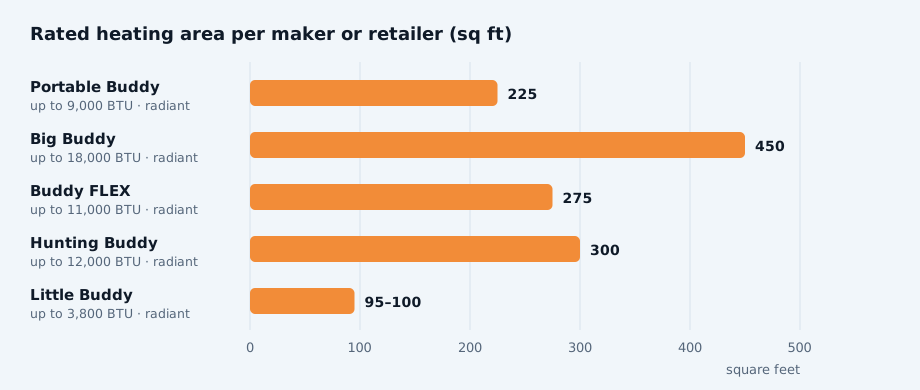
| Heater | Rated area | Fuel | Heat output | Vent needed |
|---|---|---|---|---|
| Little Buddy | 95–100 sq ft | 1 lb cylinder only | 3,800 BTU | 4 sq in |
| Portable Buddy | 225 sq ft | 1 lb or 20 lb tank | 4,000 or 9,000 BTU | 9 sq in |
| Buddy FLEX | 275 sq ft | 1 lb or 20 lb tank | 8,000–11,000 BTU | 11 sq in, ceiling and floor |
| Hunting Buddy | 300 sq ft | 1 lb or 20 lb tank | 6,000 or 12,000 BTU | 12 sq in (9 on one manual page) |
| Big Buddy | 450 sq ft | One or two 1 lb cylinders, or 20 lb tanks | 4,000, 9,000 or 18,000 BTU | 18 sq in, ceiling and floor |
Rated areas come from Mr. Heater, and vent sizes are the manuals’ minimums, so cut at least that much and keep it clear of snow.
Flip-over shelters
A flip-over is a sled with a fabric top that folds over one or two anglers. The space is small and tight, and the heater sits close to your legs, the walls and the sled tub.
The Little Buddy was made for this. It gives 3,800 BTU, sits on its own cylinder, weighs about 6 lb and needs only a 4 sq in vent, which suits a small shelter on a mild day.
Its limits show in hard cold. It has one setting, no hose option and a single cylinder that fades below 20 °F, so many flip-over owners run a Portable Buddy on low instead.
Watch clearance most of all in a flip-over. The fabric is close on every side, and a Portable Buddy needs 30 in of open space overhead and 24 in ahead of the burner, per its manual.
Hub shelters
Pop-up hubs range from two-person cubes to big multi-sided models. They have more air and more room for clearances, plus a door that lets wind in each time it opens.
For a two or three person hub, the Portable Buddy is our default at 225 sq ft and 9,000 BTU. The Buddy FLEX and Hunting Buddy fill the gap toward 300 sq ft, with variable or two-step heat.
Large hubs are Big Buddy territory, rated for 450 sq ft on 18,000 BTU. That top setting needs two 1 lb cylinders or a 20 lb tank, so plan the hose and tank setup along with it.
Hub fabric frosts and drips once a heater runs for hours. The guide to frost and dripping walls explains why the roof vent matters as much for moisture as for air.
Hard-sided shacks and wheelhouses
A permanent shack or a wheelhouse trailer is bigger, better sealed and often insulated. It holds heat well, which also means it holds carbon monoxide and moisture well.
The Big Buddy, run from one or two 20 lb tanks kept outside, is the biggest portable heater of the five. Mr. Heater gives one tank 24 to 108 hours and two tanks 48 to 216 hours.
A shack’s tight walls make the vent rule stricter, not looser. Cut the 18 sq in the Big Buddy manual asks for at ceiling and floor, keep both clear of snow, and mount a battery CO alarm where you sit.
Some shacks use a permanently installed, vented heater instead of a portable one. That is a job for a qualified installer and falls outside the five heaters here.
Never sleep in a shack with a portable heater running unless the shelter and heater are made for it and the shelter is well vented. A CO alarm can wake you, but it can’t make a closed room safe.
Where a catalytic heater fits
A catalytic heater is a quiet, flameless option for a small shelter. Small models often give about 3,000 BTU or less, which suits a flip-over or a small hub on a mild day but falls short in hard cold.
Many need a low-pressure regulator and a tank outside, and every one still burns oxygen and needs the vent its manual asks for. The radiant or catalytic guide compares the two kinds of heat in full.
Matching heater to shelter, in short
- One or two anglers in a flip-over on mild days, the Little Buddy
- The Portable Buddy for a flip-over in hard cold, or a hub for two or three
- A mid-size hub where you want finer control, the Buddy FLEX or Hunting Buddy
- A big hub or a shack, the Big Buddy on a 20 lb tank outside
- A small shelter where silence matters more than heat, a small catalytic heater
Whatever the shelter, every heater here burns oxygen. Vent high and low, keep the heater clear of walls and bags, and carry a battery CO alarm.
The best ice fishing heater for a hub is our top pick, explained in the top pick section. The full list of picks covers the other four.
If your hub seats two or three
The Portable Buddy covers 225 sq ft on 9,000 BTU and drops to 4,000 BTU when the day turns mild. It takes either a 1 lb cylinder or a remote 20 lb tank, and it needs only a 9 sq in vent, which suits most small and mid-size hubs.