Radiant or catalytic, which ice fishing heater runs better
Both kinds of heater burn propane, and both use up oxygen in a closed shelter. They differ in how much heat they give, what fuel setup they need and which safety shut-offs come built in.
How each one makes heat
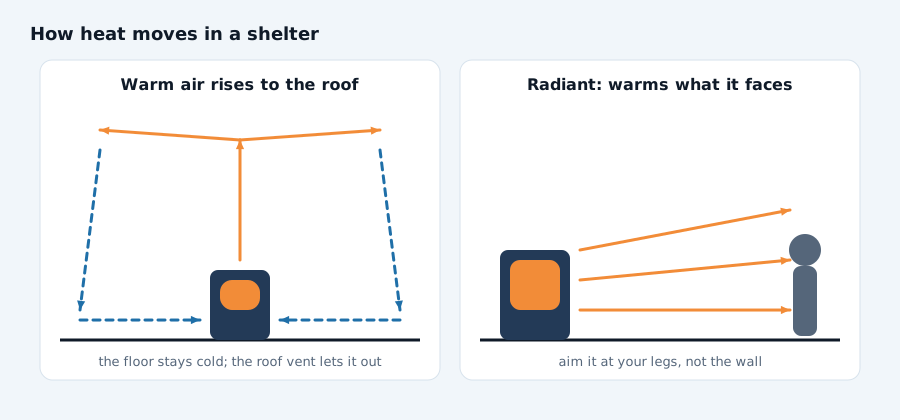
A radiant propane heater such as a Mr. Heater Buddy burns gas across a ceramic burner face. The face glows orange and throws heat straight at whatever it faces, the way a campfire warms your front.
A catalytic heater has no flame. Propane meets a catalyst-coated pad, reacts at a lower temperature and gives off gentle radiant heat from the whole pad.
Both still burn propane with oxygen from your shelter. Both give off water vapor and can make carbon monoxide if something goes wrong, so the flameless label is no reason to skip a vent.
The two types side by side
| Radiant (our five Buddy heaters) | Catalytic (typical small models) | |
|---|---|---|
| Heat output | 3,800 to 18,000 BTU across the five | Often about 3,000 BTU or less |
| Fuel | 1 lb cylinders, or a 20 lb tank on a Buddy hose (not the Little Buddy) | Often low-pressure propane through a regulator hose from a tank |
| Ignition | Piezo spark or battery pulse | Piezo starter on most models |
| Safety shut-offs | ODS and tip-over switch on all five | Varies; some have only a thermocouple valve |
| Vent needed | 4 to 18 sq in by model | Set by each manual, high and low |
| Sound | Quiet | Near silent |
| Price band | $ to $$ | Varies by model |
Heat and shelter size
This is the widest gap. Small catalytic heaters sold for tents and shelters often top out around 3,000 BTU, less than the Little Buddy, so they take the edge off a small space rather than heat a hub.
Larger catalytic models exist, but they cost more and still give less heat than the bigger Buddies. The radiant Buddies run from 3,800 BTU to the Big Buddy’s 18,000, enough for a large hub.
A radiant face also warms you directly, which helps in a drafty shelter where warm air keeps escaping. The guide to sizing the heater to your shelter matches output to flip-overs, hubs and shacks.
Fuel and cold weather
The Buddy heaters run on a 1 lb cylinder, and all but the Little Buddy also take a 20 lb tank outside on a hose. That flexibility counts on the ice, where a small cylinder fades below 20 °F.
Many catalytic heaters want low-pressure gas, fed through a regulator hose from a tank kept outside. Check whether a model screws onto a 1 lb cylinder before you buy, because many need a regulator or an adapter first.
Lower output also means lower fuel use, so a pound of propane lasts longer than on a Buddy set to high. The guide to propane in the cold explains why a big tank outside holds up better than a small cylinder.
Safety features and venting
Every Buddy carries an ODS that shuts the heater off as oxygen drops, plus a tip-over switch. Catalytic heaters vary, and some rely on a thermocouple valve alone, so read the manual for both features before you buy.
A flameless pad still burns propane and uses the oxygen in your shelter. Give a catalytic heater the vent area its manual asks for, one opening high and one low, and set it on a stable spot or a wall mount.
Neither type detects carbon monoxide. Minnesota DNR says not to rely on low-oxygen shut-offs, and the carbon monoxide guide explains why a battery CO alarm belongs in every shelter.
A new catalytic pad can give off a propane odor the first few times it lights. Light a new heater with the vents open, and treat any smell that lingers as a leak to check with soapy water.
Moisture, noise and comfort
Both types add water to the air at the same rate per pound of propane. A small catalytic heater burns less each hour, so it adds less, though it also gives less heat to push moist air out the roof vent.
The frost and condensation guide covers the venting habits that keep a shelter dry with either type. On noise, a catalytic pad is close to silent, while owners praise the Buddies for being quiet.
Neither type needs power to run, which suits a shelter miles from an outlet. The Buddy FLEX and Hunting Buddy use a small battery for ignition only, and the rest light with a piezo spark.
Cost, brands and which runs better
Catalytic heaters span a wide price range, and many need a regulator hose on top of the heater. Most Buddy heaters sit in the $$ band from $100 to $180, and the Little Buddy comes in under $100.
Mr. Heater dominates radiant shelter heaters, and catalytic choices built for the ice are thinner. The brand guide covers Mr. Heater, Clam and the other makers you will meet in the tackle shop.
For most ice anglers a radiant heater runs better. It gives more heat for less money, works on cylinders or a tank, and brings an ODS and a tip-over switch on every Buddy model.
Our Portable Buddy review makes the case for the heater that suits most shelters. The ice fishing heater buying guide compares all five, with the comparison table and the Portable Buddy card showing the trade-offs at a glance.
If you want the heater that suits most shelters
The Portable Buddy gives 4,000 or 9,000 BTU, an ODS and a tip-over switch, and it burns from a small cylinder or a remote 20 lb tank. It heats more space than a small catalytic heater, though it still needs vents and a CO alarm.