How many BTUs your ice shelter heater needs
A heater that is too small leaves you shivering over the hole, and one that is too big drains cylinders and needs more vent than your shelter can spare. This guide turns the makers’ rated areas into a way to size a heater for a fabric shelter, then turns BTUs into pounds of propane.
What a BTU rating tells you
A BTU (British thermal unit) is the heat that warms one pound of water by one degree Fahrenheit. Heater ratings are BTU per hour, so a Portable Buddy on high puts 9,000 BTU into your shelter for every hour it burns.
That rating is also a fuel rating in disguise. Propane carries roughly 21,600 BTU per pound, so every BTU the heater gives you comes out of the cylinder, and the high setting drains it more than twice as fast as low.
What the makers’ rated areas assume
Divide any Buddy heater’s top output by its rated area and you land on about 40 BTU per square foot, from the smallest model to the largest. That is the yardstick Mr. Heater uses across the line.
Those ratings describe a space that holds its heat. A fabric shelter on the ice is the opposite, with thin walls, a frozen floor, open holes and a vent you must keep open, so read the rated area as an upper limit and not as a target.
Wind and cold matter more than floor size. Owners say the Little Buddy keeps a pair of anglers comfortable in a small shanty when the day is mild, yet it falls short in hubs much past 100 sq ft and on bitter, windy days.
The five heaters by BTU and rated area
The output and area figures come from Mr. Heater. The vent column is the minimum fresh-air opening each manual asks for.
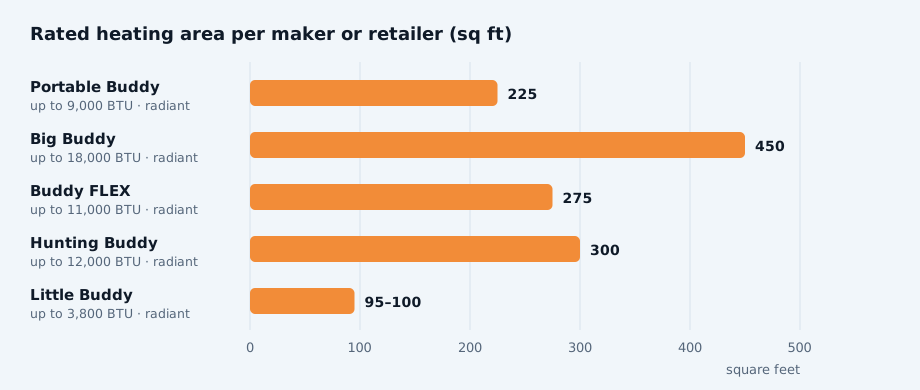
| Heater | Output | Rated area | Vent needed | Shelter it suits |
|---|---|---|---|---|
| Little Buddy | 3,800 BTU, one setting | 95 sq ft (maker copy: up to 100) | 4 sq in | Small 1–2 person flip-over |
| Portable Buddy | 4,000 or 9,000 BTU | 225 sq ft | 9 sq in | 2–3 person hub |
| Buddy FLEX | 8,000–11,000 BTU | 275 sq ft | 11 sq in, ceiling and floor | Mid-size hub |
| Hunting Buddy | 6,000 or 12,000 BTU | 300 sq ft | 12 sq in (one page says 9) | Mid-size to large hub |
| Big Buddy | 4,000, 9,000 or 18,000 BTU | 450 sq ft | 18 sq in, ceiling and floor | Large hub or wheelhouse-style shelter |
All five are radiant heaters, so the 40 BTU yardstick holds across the table. A small catalytic heater often gives about 3,000 BTU or less, which only takes the edge off a small shelter in hard cold, as our radiant or catalytic guide explains.
Every spec row for the five, from weight to warranty, sits in the comparison table on the homepage.
Measure your shelter, then pick a step
- Measure the floor: length × width in feet. A hub with a 6 × 8 ft floor is 48 sq ft
- Count the anglers: one or two in a flip-over need far less heat than four in a hub
- Judge the worst day: wind, temperatures below 20 °F and a door that opens often all push you up a step
- Match the settings: pick the heater whose low setting suits a calm day and whose high setting covers the worst one
A shelter floor rarely comes close to the rated areas above, so on paper even the smallest heater covers it. The useful question is which heater lets you sit on low most of the day and still has a high setting for the windy afternoon.
That is why the Portable Buddy is the default for a two- or three-person hub. Its 4,000 BTU low setting keeps a calm day mild, and 9,000 BTU on high gives you reserve.
When the hub is large and the crew bigger, the Big Buddy steps up to 18,000 BTU, and owners say it can hold a big hub at shirt-sleeve comfort on that setting. Our guide to flip-overs, hubs and shacks goes through each shelter type in more detail.
Why bigger is not better in a closed shelter
A heater that is too big for the shelter costs you fuel and fresh air. You end up switching it off and on, or running it on high with the door unzipped, and both waste propane.
The fresh-air cost is easy to see in the manuals. Across the Buddy line the required vent grows by roughly one square inch for each 1,000 BTU the heater can put out, so the Big Buddy wants 18 sq in where the Little Buddy gets by with 4.
Bigger holes let more of your heat escape, so an oversized heater partly fights itself. How to cut and place those openings is covered in our guide to venting a shelter by the square inch.
From BTU to pounds of propane
Each disposable 1 lb cylinder carries 16.4 oz of fuel, which works out near 22,100 BTU. Divide that by the heater’s output and you get its theoretical burn time on one cylinder, before cold weather takes its cut.
- 3,800 BTU (Little Buddy): about 5.8 hours, close to the manual’s figure of about 5
- 4,000 BTU (any Buddy on low): about 5.5 hours
- 9,000 BTU (Portable Buddy on high): about 2.5 hours, so the manual’s 3 to 6 hours leans on low
- 18,000 BTU (Big Buddy on high): about 1.2 hours per pound, which is why high needs two cylinders or a tank
A 20 lb tank holds roughly 432,000 BTU, enough for about 48 hours at 9,000 BTU. That matches the low end of the 48 to 110 hours Mr. Heater gives the Portable Buddy, and the hose and tank rules are in our 20 lb tank setup guide.
Cold shrinks all of these numbers. Every Buddy manual warns that run times drop significantly below 20 °F on continuous use, and the physics is in our guide to why small cylinders fade in deep cold.
Sample shelters
- One angler in a flip-over: the 3,800 BTU of a Mr. Heater Little Buddy covers a mild day; on a bitter, windy one owners want more
- Two or three in a hub: the Portable Buddy on low most of the day, high when the wind picks up
- A mid-size hub full of gear: the Buddy FLEX (8,000–11,000 BTU) or the Hunting Buddy (6,000 or 12,000 BTU) fills the gap
- Four or more in a big hub or wheelhouse-style shelter: the Big Buddy, fed by a 20 lb tank that stays outside
For the whole lineup in one place, start with our best ice fishing heater comparison, or jump to sizing and run time on the homepage.
For a hub that seats two or three
The Portable Buddy is rated by Mr. Heater at 4,000 or 9,000 BTU for up to 225 sq ft, and its manual asks for a 9 sq in vent. It idles on low most days and keeps high in reserve, while a big group hub is better served by the Big Buddy.