Why a heater’s 1 lb cylinder fades in deep cold
On a calm day at 25 °F your heater purrs, and on a morning below zero the same cylinder frosts over and the glow sags. That is physics, not a broken heater, and this guide explains it and what to do about it.
What happens inside a cold cylinder
A propane cylinder holds liquid with a layer of vapor above it, and your heater burns the vapor. The pressure that pushes vapor to the burner depends on the temperature of the liquid, and it falls as the liquid cools.
Propane boils at about −44 °F, so in principle it still makes vapor on the coldest day you will fish. The trouble is the rate, because a small cylinder at low pressure can’t make vapor as fast as a heater on high wants it.
Why the cylinder frosts as it runs
Turning liquid into vapor takes heat, and the propane takes it from itself and the steel around it. Heavy draw chills the liquid further, the pressure sags again and the heater’s output follows.
That is the frost band you see on a running 1 lb cylinder. Mr. Heater’s own FAQ says that in very cold weather a small cylinder can’t vaporize fast enough and frosts, and it suggests wiping off the frost or moving to a larger remote tank.
The pressure comes back once the heater is off and the cylinder warms. A cylinder that seemed empty on high often still has fuel in it an hour later.
What the manuals say about 20 °F
Each Buddy manual says continuous use under 20 °F can cut run times significantly, and all but the Little Buddy’s point you to a 20 lb tank for that kind of weather. The Buddy FLEX goes a step further, with a minimum ambient of 0 °F in its spec table.
The setting matters as much as the weather. Each 16.4 oz cylinder carries close to 22,100 BTU, which on paper lasts about 2.5 hours at 9,000 BTU and about 5.5 hours at 4,000 BTU.
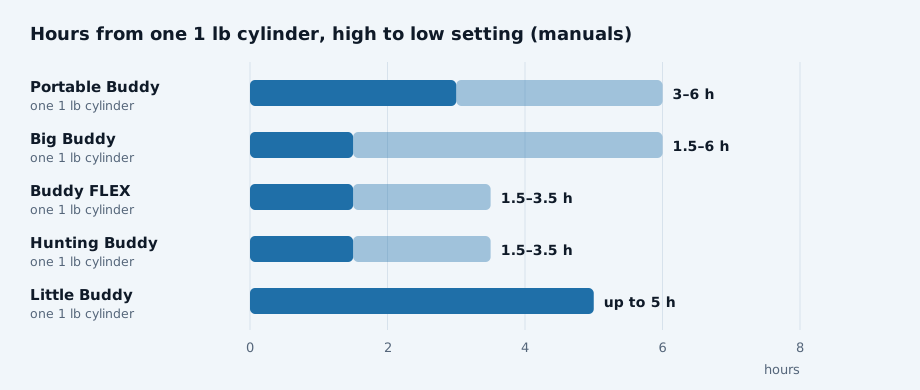
| Heater | One 1 lb cylinder (manual) | Cold-weather route |
|---|---|---|
| Little Buddy | About 5 hours | 1 lb only, no hose option |
| Portable Buddy | 3 to 6 hours | 20 lb tank outside on a Buddy hose |
| Buddy FLEX | 1.5 to 3.5 hours | 20 lb tank on a Buddy hose; rated down to 0 °F |
| Hunting Buddy | 1.5 to 3.5 hours | 20 lb tank outside on a Buddy hose |
| Big Buddy | 1.5 to 6 hours (low and medium only) | Two cylinders or a 20 lb tank for high |
These are fair-weather figures. Below 20 °F expect less, and the high setting suffers most because it asks the cylinder for vapor fastest.
The Big Buddy shows the limit plainly, since Mr. Heater’s Buddy FAQ says one 1 lb cylinder runs it on low and medium only. Our BTU guide shows how each setting turns into fuel burned per hour.
Signs the cold is starving your heater
- Frost on the lower half of the cylinder, spreading while you run on high
- A burner glow that dims or turns patchy though the cylinder is not empty
- Output that falls off within the first hour on a cold morning
- A pilot that drops out, then relights once the cylinder has warmed
That last sign shares symptoms with a dirty pilot tube and a draft, so read our guide to a pilot that won’t stay lit before you replace any parts.
Fixes that work
- Move to a 20 lb tank: the larger body of liquid holds its pressure far better; keep it outside and run a Buddy hose in. Buddy heaters are tested up to 20 lb, and bigger tanks are not recommended
- Run on low: a smaller draw lets the cylinder keep up, and the theoretical burn time more than doubles
- Rotate cylinders: swap a frosted cylinder outdoors for one that has rested, and let the first recover
- Carry spares in an insulated bag: they start warmer than cylinders left loose on the sled all day
- Wipe the frost off: Mr. Heater’s FAQ suggests it as a stopgap
Hookup details live in our guide to the 20 lb tank, hose and filter.
What not to do
Never warm a cylinder with the heater, a torch or any flame, and never park it in front of the burner face. Keep spares out of the sun and away from heat, and store them outside the shelter overnight.
Don’t refill 1 lb cylinders to stretch a cold weekend either. PHMSA calls these DOT-39 cylinders strictly non-refillable, and federal rules make it illegal to transport refilled ones.
Burning propane also puts water vapor into the shelter air, a separate cold-weather headache from the frost on the cylinder. Our guide to frost and drips in a heated shelter deals with that one.
Which heater suits deep cold
The Little Buddy can’t take a remote tank, so in deep cold its own small cylinder sets the ceiling. It is the cheapest of the five and fine on mild days, as our look at a cheap ice fishing heater under $100 explains, but deep cold exposes it.
Every other Buddy heater takes a 20 lb tank on a hose, which is the cold-weather fix that counts. Compare them in our ice fishing heater picks, check sizing and run time, or go straight to the Portable Buddy card.
For days well below 20 °F
The Portable Buddy runs on a 1 lb cylinder for short trips and on a 20 lb tank kept outside the shelter when the cold bites, as Mr. Heater advises below 20 °F. Its manual gives 48 to 110 hours from a 20 lb tank.